.svg)


.jpg)
While climate policy debates and deregulation fears dominate headlines, a fundamental market shift is quietly reshaping the competitive landscape for businesses. Companies with meaningful green revenues are growing 2x faster than conventional counterparts, accessing capital at significantly lower rates, and commanding premium valuations in public markets.
The World Economic Forum's latest analysis in collaboration with Boston Consulting Group strongly advocates for investment in green growth, in the report titled ‘Already a MultiTrillion-Dollar Market: CEO Guide to Growth in the Green Economy’.
The analysis highlights that the green economy has already surpassed $5 trillion in annual value and is projected to exceed $7 trillion by 2030. What makes this particularly compelling for executives isn't the environmental narrative, but the business performance data.
The green economy, which in the report is defined as ‘commercial solutions with a clear environmental purpose or solutions that are a direct response to environmental challenges’, is already among the world’s top two growth industries, has become the second-best performing sector globally, trailing only technology in growth rates over the past decade.
The market has already rendered its verdict
Between 2020 and 2024, data from 6,500+ publicly listed global companies analysed by London Stock Exchange Group (LSEG), green revenues grew in aggregate by 12% annually – twice as fast as conventional business lines.
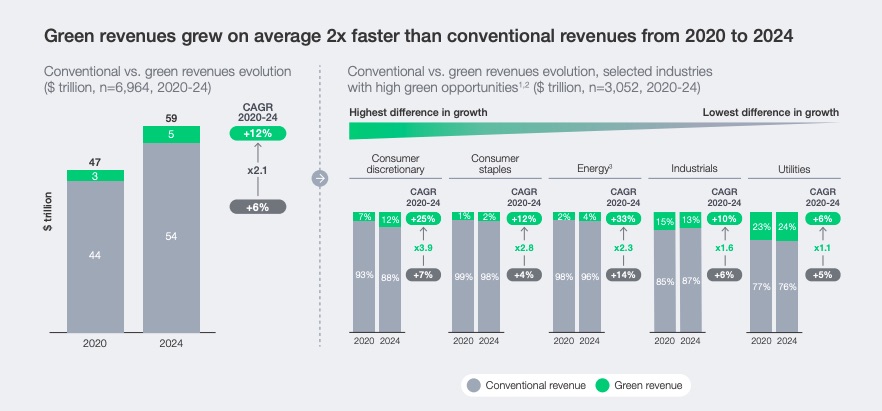
Energy companies provide the most dramatic example: their green revenues grew at 33% CAGR over this period—more than double the 14% growth rate of conventional energy revenues. Even in mature industrials, where green solutions already represent substantial revenue pools, demand continues expanding at nearly 10% annually while some traditional markets stagnate.
“The green market is one of the greatest economic opportunities of our time. From clean energy to sustainable finance, it is driving new engines of growth. Companies that lead today are not just future proofing; they are creating the markets of tomorrow,” says Feike Sijbesma, Founder and Co-Chair, Alliance of CEO Climate Leaders and Chair, Supervisory Board of Royal Philips.
Market forces, including customer demand, investor preference, and supply chain requirements, have created sustainable momentum that persists regardless of policy shifts.
The business case for investing early in green growth
The report analysis isolates three specific financial advantages that green companies consistently demonstrate over conventional competitors. Each represents a measurable competitive moat that compounds over time.
Green revenues are growing faster than conventional revenues
Companies with material green revenues are accessing fundamentally different market dynamics. Green business lines grew at a 12% CAGR from 2020-2024 compared to 6% for conventional revenues, with this premium existing across nine of the eleven largest industry sectors analysed.
Over half of the companies achieving greater than 30% annual growth had at least 10% green revenues in 2024. This correlation reflects exposure to markets where customer willingness to pay premiums, regulatory support, and innovation opportunities create accelerated demand curves.
Consider the broader context: solutions to decarbonize more than 50% of total global emissions are already cost-competitive without subsidies. Solar photovoltaic capacity projections for 2030 grew 84x faster than expected in the early 2000s, with wind growing 11x faster and EV battery deployment 9x faster than initially forecasted.
Capital access is cheaper for green companies
Financial markets have moved beyond ESG screening to fundamental repricing of risk and growth potential. The report’s analysis found that companies with green revenues secure a lower cost of capital compared to companies without green revenue streams, and the difference is significant at 43 basis points.
New debt financing vehicles in the market, which tie capital allocation to ESG performance, often offer lower-cost financing to companies funding green projects (e.g. green bonds). The companies in green markets can demonstrate a lower risk profile, which helps justify a lower cost of debt.
Companies that can provide investor-grade transparency around their environmental impact and green revenue trajectories qualify for this expanding pool of lower-cost capital.
Greener companies are enjoying higher valuations
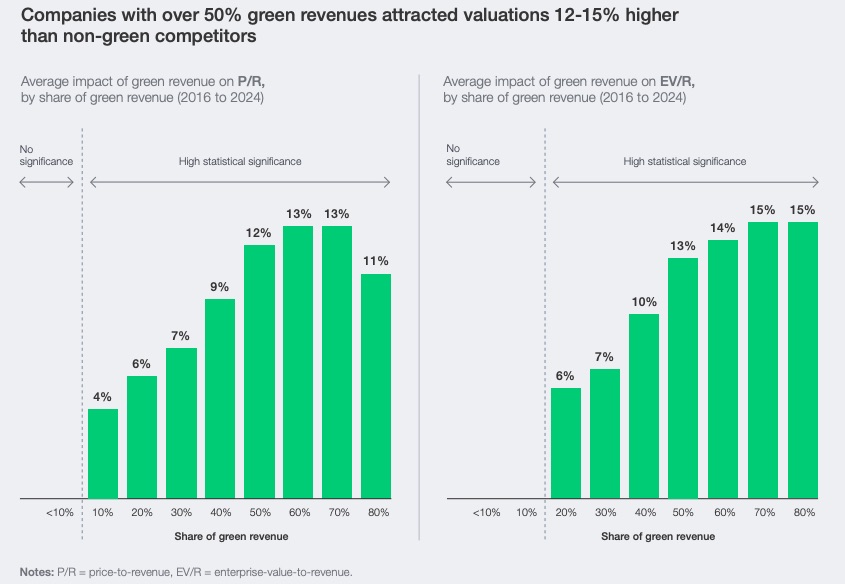
Perhaps most striking is the valuation premium that markets assign to companies with meaningful green revenue exposure. The WEF analysis covering 2016-2024 found that companies with around 20% green revenues enjoyed 6% higher price-to-revenue and enterprise-value-to-revenue multiples compared to conventional competitors.
Companies with 60-70% green revenues commanded 12-15% valuation premiums, with these effects persistent across time periods and robust across pre- and post-COVID market conditions. The premium applies broadly, with particular strength in utilities, industrials, and consumer-facing sectors.
The drivers are logical: green companies demonstrate exposure to higher-growth markets, benefit from supportive regulation, access cheaper financing, and face lower perceived long-term downside risk. Investors reward this combination with higher multiples, creating a virtuous cycle where premium valuations support lower-cost equity raising and more aggressive strategic investments.
What separates winners from laggards: Lessons from green economy leaders
The report's analysis of successful green companies, including interviews with Alliance of CEO Climate Leaders members, reveals four critical priorities that differentiate market winners from those struggling to capture green growth opportunities.
1. Purpose and strategy: Green ambition anchored in core business strategy
Successful companies embed green growth at the centre of their corporate strategy, not as an adjacent initiative. Schneider Electric exemplifies this approach—by 2024, 90% of the company's €38.2 billion in revenues aligned with EU Taxonomy green activities, growing fourfold from €9 billion in 2003, while earning recognition as the world's most sustainable company.
2. Value proposition: Competitive solutions that happen to be green
Effective green companies develop sharp value propositions rooted in genuine customer needs. "Being greener" is not enough of a value proposition when marketed as a standalone benefit. Johnson Controls demonstrates this principle through high-efficiency heat pumps that deliver compelling economics: a Spanish food company achieved approximately €1.5 million in annual energy savings while reducing CO₂ emissions by roughly 2,000 tonnes, while using the company’s heat pumps.
3. Operating model: Built for rapid scale
Leading companies create focused cultures with lean, integrated and highly accountable teams that unite technical, commercial, and sustainability expertise. Leading CEOs leverage advanced tech (including AI) to automate core processes to become more cost-effective, reduce errors, and anticipate market demands. It is critical to deploy digital tools to track performance and emissions with precision and granularity.
4. Growth accelerators: Technology maturity, ecosystem shaping, smart capital
Winners push relentlessly for technology maturity and cost efficiency, recognising that "green premiums" create growth ceilings over time. They shape regulatory environments and build ecosystem partnerships—like IKEA's work across private and public sectors to establish mattress recycling policies that divert over 2 million mattresses annually from incineration.
The measurement imperative: carbon intelligence as business infrastructure
Here's where the practical challenge emerges for most enterprises: you can't manage what you can't measure, and you can't capture green growth premiums without granular carbon intelligence.
The WEF report identifies carbon measurement and accounting as one of seven critical enabling sectors under the broader theme of financial & enabling solutions for mitigation.
Consider the operational challenge:
- Companies pursuing green revenue growth need product-level carbon footprints to enable green product certification and premium pricing.
- Those accessing sustainability-linked financing require investor-grade disclosures with auditable data trails.
- Organisations optimising green supply chains must have supplier-level emissions visibility to make carbon-informed procurement decisions.
Most enterprises lack this granular carbon intelligence. Traditional approaches, such as spend-based accounting and enterprise-level inventories, don't provide the granular product and supplier-level data required for green business strategies. This creates a fundamental infrastructure gap between sustainability ambition and business execution.
This is the challenge that CO2 AI is focused on tackling. Allowing organisations to build a carbon intelligence infrastructure that bridges that helps companies unlock green growth. Clients can calculate product carbon footprints at scale, engage suppliers for primary data collection, and embed carbon considerations into procurement and pricing decisions using our technology
The window of opportunity is closing to become a first-mover
The data reveals a market inflection point where first-mover advantages in green business development are still capturable, but the window is narrowing. Companies that build green capabilities now position themselves to capture disproportionate value as markets mature and competition intensifies.
The risk of waiting compounds over time. As green markets expand and technologies mature, entry becomes harder, and premiums compress. Early movers benefit from establishing customer relationships, securing favourable supplier partnerships, accessing better talent, and building operational experience before markets become crowded.
The question facing leadership teams isn't whether the green economy will continue growing; it's whether their organisations will be positioned to capture that growth. Building carbon intelligence capabilities, developing green product strategies, and establishing supplier engagement infrastructure takes time. The companies beginning this work today will be tomorrow's market leaders in the $7 trillion green economy.



.svg)

.svg)

What would you like to read next?